Monday, 7 November 2016

The Dutch Bicycle


The Dutch had fallen in love with bicycles more than a century ago and the love continues growing today. Most are comfort bikes used for daily transportation, shopping and just getting around. There are no helmet laws and bicycle traffic lanes are a standard part of street planning. Seventy percent of daily journeys are in the seven kilometers range. There are laws requiring houses to have a bicycle shed and there are bike racks in front of all shops. Bicycle parking lots are large and standard and there are even parking barges on the canals.

The first Dutch bike manufacturer began in 1869 and this followed with some fifty factories and hundreds of brands. Over the decades, many failed or were absorbed by more successful companies. The three major ones that remain today are Simplex founded in 1887, Gazelle from 1892 and Betavus since 1904.

Among the current statistic on bicycles in Amsterdam is that 490,000 free-wheeling feisters cycle two million kilometers every day. Amsterdam has 220,000 cars and 550,000 bicycles. There are 400 kilometers of bike paths within the city and there are free bike ferries to the northern parts of the harbour.

Throughout the country, there are countless of bicycle shops selling new and used bikes. Many are also repair shops with most of them very busy. We found such a shop on the main street of Harlingen, not far from the harbour, as we were looking for full sized gently used bikes. There was a good selection to choose from and we bought two female models from Bevatus, referred to as a granny bikes. The trend in the Netherlands is that most men now ride the more comfortable low instep female bikes, abandoning the classic male bike with the high crossbar.

In this picture is the local bicycle club in Rotterdam around 1920. A few drop handlebars are showing, but the rest are standard bikes. In the center of the picture, with a bushy mustache is my grandfather and the boy to the far right is my father. Several of the men are my uncles.

Sunday, 6 November 2016

Billy The Goat

Sunday, September 1, 2013 A page from our canal boating in France
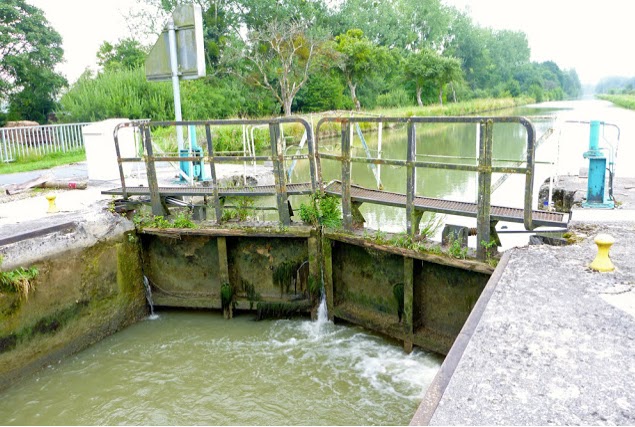
Today the locks were more gentle, lower in height and easier to manage. On our approach to this lock, I spotted Billy the Goat in the orchard. 

Billy was trying to reach one more apple as he had finished all that had been in his grasp. Perhaps there was just one he had missed.


I walked across the old lock gate to reach the orchard, as the lock begins to fill.


Billy saw me coming and I was very pleased to see that he was securely tied down. He gave me a fixed stare, after all, it was his orchard.


He was accustomed to having his photo taken as he gave me his good side profile.


Next was the passport photo shot and no smile required.


I returned to the barge as the lock had filled.


Passing the old lock house the dog came to greet me with some fatigued and hoarse barks.


After he had done his duty, he went back to the guard post to keep away robbers and thieves.
Everything in this lock was either old, tired, dilapidated or an antique.

Bon jour, one last stare


Saturday, 5 November 2016

Ayutthaya


The iconic and most photographed Buddha is the Buddha entwined in the tree.


With the invasion, by the Burmese army in 1767, many of the statues were vandalized and beheaded.


The site was left abandoned until the early 1950s when the Department of Fine Art of Thailand began their restoration work.


There is no record of how the Buddha's head became entwined in the roots of the tree.


There are many theories one being that after removing the Buddha's head it could not be lifted over the wall. It is believed that the thief hid it among the roots of a tree and either forgot about it or could not find it.

Friday, 4 November 2016

Wat Maha That


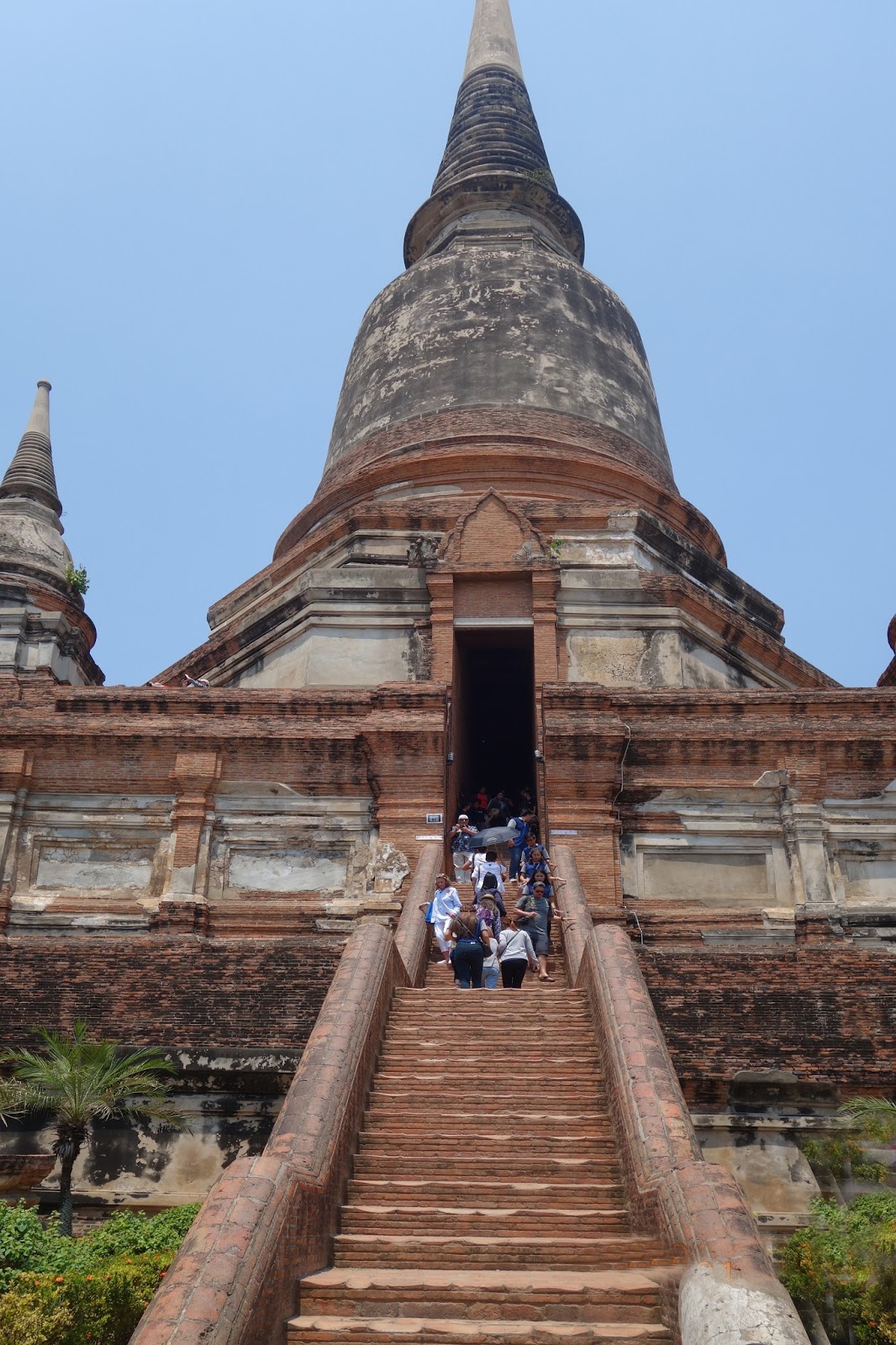
Better known as the Monastery of the Great Relic and is located on the city island in the central part of Ayutthaya. The monastery stood on the west bank of Khlong Pratu Khao Pluak, a prominent canal at the time. In the past, the temple had been surrounded by canals and moats, most likely for strategic and atheistic reasons. The canal was filled in towards the early part of the 20th century making it more accessible. 


The structure has been registered as a National Historic site by the Fine Arts Department as soon as March 1935 and is part of the Ayutthaya World Heritage Historical Park. 

The exact dates of the establishment of Wat Maha That are difficult to access.


The Dutch, who seems to be better at keeping records and also had a trading interest in Ayutthaya, had one of their chief merchants document some of the histories in 1640. According to Jeremias Van Vliet, of the Dutch East India Company, it was Prince U-Thong, the next King Ramathibodhi I, from 1314–1369, who built Wat Maha That.


Later chronicles mentioned that King Boromaracha II, 1424-1448 attacked Angkor and had a large number of objects removed from their temples to place in Wat Maha That.


Wat Maha That was one of the most prime monasteries of the Ayutthaya kingdom because of the religious centre and the enshrined relics of the Buddha.


Van Vliet, in 1638, described the splendour of the yearly Royal processions to Wat Maha That. It was on that occasion where the Ayutthaya Kings made their offering to their Gods and prayed for the welfare of the country.


Further mentioned in 1595, that is most likely Wat Maha That, had the interest of gemstone merchants from Flanders and stayed there for eight months.


Van Vliet also mentioned of towers collapsing and later restored. Restoration of the site seems to be an ongoing project and with each section, the prangs were made taller. 


The Wat Maha That site has been prone to lootings and damage by illegal excavations.


Johannes Vingboons, a Dutch cartographer, created a painting in 1665 and believed to be from information gathered during the time he lived in Ayutthaya.

Thursday, 3 November 2016

Bangkok, Thailand


Our cruise ship docked outside of Bangkok with only a short stay and a list of day excursions. The tours included the city of Bangkok, the famous Pattaya Beach or the ancient Ayutthaya complex. All of them a distance away. 


I had visited Pattaya Beach and Bangkok forty years ago and I decided to give  Bangkok and Pattaya Beach a skip and visit the Ayutthaya complex instead.


Bang Pa-In Royal Palace is the former Summer Palace used by the Thai kings. Built in 1632 but fell into disuse and was vacated. It then became overgrown and not till the early 19th century was it restored with garden and new statues added. 


Ho Withun Thasana is the brightly painted lookout tower.


Heavenly Light or Wehart Chamrunt Palace

No shortage of craftsmanship and intricate woodwork


After a full day of Temples, Kings and Buddhas we returned to the cruise ship

It was a thoroughly enjoyable day
.

Wednesday, 2 November 2016

The Art of Selling and Selling Art


Selling seems to be a primary form of employment as individual merchants are everywhere supporting a large population. 


They arrive on scooters, a mobile unit with the goods strapped to each side.


Often it is a bicycle with an incredible load.


Then there are those who arrive on foot


Food gets freshly prepared on the sidewalk

We made a stop at the lacquer factory with very bright pieces of art

ornate furnishing and painting to match

a collection of ornate hair pins 

It had been another shopping day without a purchase.


Tuesday, 1 November 2016

The Road To Saigon

I have become aware of traffic jams of mega proportion as I sold my car ten years ago. I now participate in Vancouver's transit system and with my monthly pass, I go everywhere.   


The roads in Vietnam are packed with scooters and most wearing a sort of facemask against the other scooters fumes.


For other, it is a two wheel delivery truck.


Then there are the roadworks 


and the ones stuck in them.