Monday, 14 November 2016

Jackass

I came across this statue along the canal in Gouda and it caught my eye and needed a  closer look. I was a bit puzzled and looked around for a plaque of explanation: a fable or perhaps a poem, but there was none.

It is a statue of a man carrying a jackass on his back, heading in no particular direction. Made in bronze in 1998 by the sculptor Gijs Assmann, perhaps it was a play on his name and might have been called an ass before. 

Assman translates to Ashman.

Sunday, 13 November 2016

Gouda Cheese

The name Gouda is world famous and synonymous with cheese. The first mention of Gouda cheese dates from 1184, making it the oldest recorded cheese that is still presently produced.


The cheese named after the city of Gouda, not for its local production, but for the town where it has traded since the Middle Ages. Gouda acquired the sole right to trade in the cheeses produced by the Hollandic farmers. It was at Gouda city market square that the cheeses would be laid out and displayed.

On Thursday mornings, the dairy farmers from the surrounding area gather at the market square to have their cheese weighed, tasted and priced.


They dress for the part and lay out their cheeses. The young milkmaids are there as well, dressed red-white-and-blue outfits wearing white lace caps, handing out cheese samples for tasting.

The term "Gouda" is not protected and therefore is used around the world for cheese made in Gouda-style. "Noord-Hollandse Gouda" and "Boerenkaas" are registered in the EU as a Protected Geographical Status and can be made only in the Netherlands and only from milk produced by Dutch cows. Some 300 Dutch farmers still produce cheese and "Boerenkaas", Farmers Cheese, is made in the traditional manner using unpasteurized milk.


As I left the cheese market, the simplicity of the street names caught my eye. They are called Achter de Vismarkt, behind the fish market, Achter de Kerk, behind the church, Achter de Waag, behind the weigh house. I guess they had no mail delivery in those days and everyone knew their neighbours.


.

Saturday, 12 November 2016

My Father the Artist


My father carried the family's given name Jan Jacobus that can be traced back into the 1700's. For centuries they had been house painters, glass repairman and stained glass artists. My father was one of a twelve children, most of whom helped in the family business of house painting. His apprenticeship started at the age of twelve and he joined his father and older brothers in that trade. Besides the cleaning of brushes, the brothers taught him to roll his cigarettes, a habit that remained with him until the end.

My father belonged to an artist group in Haarlem, which was part of the Dutch Federation of Artists Sculptors and Engravers. For acceptance into the guild, the artist's work has to be juried by nine art professors. It required five votes to qualify and his self-portrait received all nine votes; he was granted professional artist status and accepted into the guild. A portrait is a difficult object to paint and a self-portrait the most difficult, as the artist has to look into a mirror and paint what he sees. Jan Jacobus had been accurate in what he had seen.

In the later part of his life, he took private lessons from the Rijksmuseum's restorer. He experimented with methods known to the Dutch Masters mixing their paints and he learned their style of application. His goal was to become an art forger, which thankfully was short lived, as the restorer was caught and sentenced to jail as an art forger himself. My father's unfiltered smoking caught up to him and he passed away at the age of sixty-six at home.

Quite often I am asked about the family name. Could it have been Van Rijn? …probably not.

Friday, 11 November 2016

The Window Sill


Walking through the streets of Amsterdam, or barging through a small village in rural Friesland, we come across small window displays. With the drapes drawn back, the displays are a personal reflection of their owners and their willingness to share. The frequently cleaned windows host creative displays of flowers, plants, vases, candles, lamps, antiques, knick-knacks and toys. With the sidewalks so close to the windows, one cannot help but stop and look. Once we have paused, our eyes often move up to the invitation to look into their living room and into their lives. The nothing-to-hide openness, the simplicity, the cleanliness and the orderliness of life is inviting. 

In our travels in France, we notice the heavy shutters on windows. They are flung open in the morning, but there are no window displays, nor is it easy to look inside. In the early evening, the shutters are closed and the home is cut-off from the outside world. There is no sign of life. 

Through the sixteenth century, religious persecutions in Portugal, Spain and France caused many of the persecuted to move to the Netherlands, which welcomed the educated, the artisans, the artists and the free thinkers into their population. They soon assimilated and formed the open-minded, colourful and diverse nation that is the Netherlands. 

It is amazing what we see on a window sill.

Thursday, 10 November 2016

Clogs


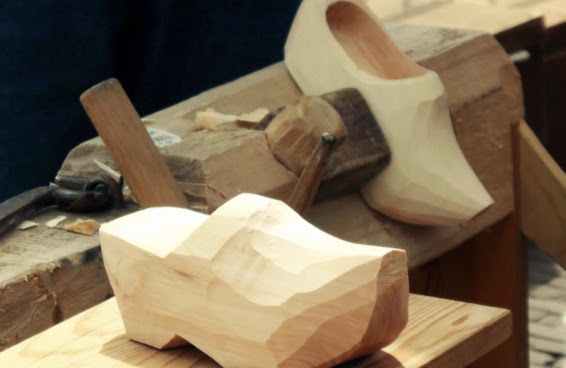
Clogs can be traced back as far as 1367 and it is most likely they originated much earlier. Today they are still worn as daily footwear. During the wet and cold periods on the farms in the Netherlands, clogs keep feet dry. Modern replicas of the iconic shape are made in rubber for rainwear and in warm fabrics for slippers. Colours have also changed from basic yellow with red trimmings to street scenes, flowers, blue and white, polka dots and cow patterns.


For the fabrication of clogs, the white Popular tree is used that are specially grown for this purpose of clog making. For the perfect pair of clogs, fresh wet wood is then cut into square blocks, carved and then smoothed into the right shape.


In the past, the smelter in IJmuiden supplied industrial clogs to the employees as safety gear, as it was the only footwear that could stand up to a splatter of red-hot molten metal without burning worker's feet. Custom made clogs were also produced in the days of dyke building to serve as fulcrums in lifting stones with crowbars. New techniques in dyke construction and the modernization of melting furnaces have meant these types of industrial clogs are obsolete and no longer produced.

Along with the traditional yellow with red clogs, villages were recognized by their individual unique colours and patterns.


Then there are the chip-carved bridal clogs, a genuine work of art, plain in colour with intricately carved designs. The suitor will present the pair to his loved one as a proposal of marriage; if she accepts them, she will wear them on their wedding day.


Today, the clog production in mainly for the tourist trade but there are still farmers who prefer the traditional clog to the more modern footwear and continue wearing them.  The durability of these clogs can outlast their owners and the worn out ones turned into decorative flowerpots.


Wednesday, 9 November 2016

Skûtsje Art


What caught our eye when we were shopping for a barge, was the artwork on our Skûtsje. It was unusual as most tjalks and skûtsjes had traditional artwork that has been around for centuries. The previous owner Henk van der Zon located an elderly Friesian lady at a boat show.


She carved facades and klicks for skûtsjes using her style, a form of primitive art. Undecided on what he should put on the facade she asked for his last name, which is van der Zon, meaning from the Sun. She came up with this beautiful inverted representation of the water cycle. Now nearly forty years later, the artist remains unknown, but we love the bright colours she had chosen.


The barge was named Nieuwe Zorg, which means new cares or concerns; we wanted to change the name into something more uplifting. I asked our broker how one went about changing a boat's name in the Netherlands. His answer came quickly: "with a brush!"


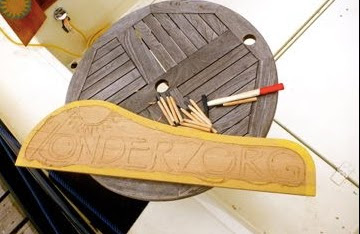
To match the image and, with a bit of play on words we changed her name to Zonder Zorg, meaning without care or carefree. We had new boards cut to size and I did the layout and started chiselling. 


I duplicated the colours from the facade and applied the final touches to the yellow sun; the brushed flipped onto my favourite trousers. I disguised the stains with embroidered butterflies, a new form of Skûtsje Art.

Tuesday, 8 November 2016

The Dutch and Their Bicycles


This photo is of Princess Juliana and  Bernard on a tandem bicycle was taken around 1930. There were many photos publicized of Queen Juliana on her bicycles.


The Dutch have a passion for bicycles and these present themselves in many colours and shapes. 

There are unusual ones, practical ones, decorated ones and collector bikes, just to name just a few. 


In the Netherlands, bicycles far outnumber the population and have become the favorite mode of transportation.


So popular in fact, that the inner core of cities has prohibited cycling, making more room for the ever-growing pedestrians.


There are the yellow rent-a-bikes that are visible throughout Amsterdam, some with some very wobbly first-time peddlers.
 
As Rastafarian taking his dog for a ride.

Do it yourself decorations which include flowers, hearts and any design you can imagine.

A candy coloured bicycle in front of a candy store.


Always lock your bike or hire a guard cat.


From a family affair 

to a Royal affair with the bicycle, Queen Juliana and Prince Bernard with the four princesses.

Twelve-year-old Princess Catharina-Amalia on her back-to-school bicycle. The down-to-earth princess has joined her classmates in this common and practical mode of transportation. This functional bike comes with milk crate at the front and not to forget the bell.

    Princess Catharina-Amalia's great-great-grandmother Queen Wilhemina on her bicycle.


In the eighties, the Gelin family went on extended bicycle trips through France, England, and Japan.