Saturday, 22 October 2016

The Sumo Wrestlers from Japan


Just before the turn of the millennium, Canadian Airlines International sponsored the Japanese Sumo Wrestlers team for their visit to Canada. It was their first time that the group travelled abroad. Along with the Sumo Wrestlers, the soil for their traditional platform was transported as well. 

They made an appearance at the Colosseum in Vancouver.

One of the wrestlers stood out and left a lasting impression with me. It was the fact that he wasn’t Japanese and towered over the others with much longer legs. 

Chadwick Rowan was born in Hawaii and stood 203 cm or 6’8” tall and weight 223 kg, or 492lb. In 1993 Chad Rowan who took on the name of Akebono Tarõ was promoted to Yokozuna.  The first non-Japanese-born holding the rank of the Grand Champion and the highest achievement in Sumo, the national sport of Japan. 

The opening ceremony was impressive with its blessings and rituals. The rules laid out and explained of this unusual game. Lots of grunting, grabbing, pushing and slapping and a few demonstrations of the match. 

During the interval, there was a tea ceremony and of interest to us both to attend.


By the time we arrive at the ceremony, we were the last in the line-up. We patiently waited our turn and watched the lovely kimono-clad hostess present the tea. Then it was our turn, with my neighbour sitting next to me, we watched the arrival of a  teapot, a teacup and finally a cookie, each time followed with a bow. At the last bow, the lady gently came forward and said, in my ear,  HURRY UP!!  I was so out of context that I burst out laughing. My friend is from France and she wasn’t going to let a tea hostess tell her to HURRY UP. There were plenty of questions to be asked and an interpreter was summoned and prolonging the tea ceremony.


We returned slightly late and missed out on a few more grunts and some sumo wedgies. It was an exciting day and we returned to our homes on the edge of the forest.

Friday, 21 October 2016

Molly and the Sumo Wrestlers


We lived on the edge of a green belt, high above picturesque Deep Cove, in North Vancouver. Tall trees block the sun early in the day and the remains of old logging still visible behind the property. Also the home of coyotes, a few stay bears and possible cougars.  The well-fenced backyard had an access gate into the woods.

The all-female household included my two daughters, myself and two felines called Molly and Daisy. Friends claimed that the spiders around the house were also female. The cats were indoor cats and we had no problem with Daisy.  Molly being more adventurous, wanted to see the outside world and we had to keep her at bay. There were coyotes chasing cats in the neighbourhood and we even found some cat collars in the woods.


We went away on vacation and asked our tenant, who lived in the suite below us to care for them. On our return, the renters advised us that Molly had escaped the day before and had disappeared into the woods. It was already late in the afternoon when the girls went looking for Molly. It was getting dark when they spotted her the forest. In turn, they called me for the rescue mission and as I made my way up the path, I spotted Molly. After calling her name, she came over towards me and I was able to grab her by the scruff of her neck. Heading down the steep incline with a firm grip on the cat, I slipped on loose gravel and fell. Molly turned around and gave me a farewell bite, before disappearing into the now dark woods along with some hungry coyotes.  

We could hear Molly meowing throughout the night. The following morning I notice that my hand was swollen and sought medical attention immediately. With antibiotics, bandage and tetanus shot we renewed our search. The girls spotted Molly up a tall tree close to the fence but behind the property in the forest. 

I called the local fire department for advice and they said that someone would come and have a look at the situation. Soon after that, a huge firetruck with lifting basket and full crew showed up. Clipboard in hand they trotted behind the property and advised me that they are unable to reach Molly as there is no access to the woods.


One firefighter recommended to nail a can of tuna high up on the base of the tree and the aroma of sun-drenched tuna will bring the hungry cat her down. More advice followed that if the tuna did not work, to find a tree logger to scale the tree and rescue Molly.


With the help of the YellowPages, telephone directory, I found a tree climber. A height impaired French-Canadian showered up only stopping to strap on his cleats and threw a large sack over his shoulder. He proceeded to climb the tree, in logger-fashion and Molly took one look at what was coming up towards her and shot up higher in the tree.  She ran along a branch and stopped at the tip of it, strong enough to hold her weight with the branch swinging up and down. With Molly now holding on for dear life, the  French-Canadian threw his hands in the air, followed by "merde" backed down and left Deep Cove, never to be seen again.


The next call was to the local SPCA to ask them for advice. “ah yes” they replied “we use Wally-the-cat-rescuer in situations like that“  and gave me his phone number. An immediate phone call went to Wally, who lived about 30 minutes away, quoted a price and was en route.

A second later after I hung up, the phone rang again. It was my neighbour a few doors down who had last minute free tickets to see the Japanese Sumo Wrestlers. We had to leave in 10 minutes and would I join her?

But of course……


Thursday, 20 October 2016

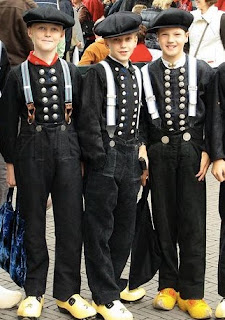
The Dutch Costume

With the activity of VOC in Asia, they were importing to the Netherlands goods such as fabrics, printed cotton and luxurious silks. These items were well received with some patterns copied or their designs adapted in other forms.  Frequent trips to Amsterdam was made province-wide as new and unusual items arrived with the return of the trading ships. 

Chintz was originally a woodblock printed or stained calico, produced in India from 1600 to 1800 and used domestically for bed covers, quilts and draperies. The returning Dutch traders were bringing samples of this Indian Chintz to Europe and the French and English made it famous in their home decor. Chintz fabrics, with their leaf and flower motifs, can be seen in old Dutch paintings along with handwoven carpets and rugs of similar designs and were integrated into the local decor. 


They incorporated the traditional Japanese hairstyles of that time and took a liking to their pleated skirts, fabrics and clothing designs.


Along the shores of old Zuider Zee are the picturesque towns of Spakenburg and Hindenlopen, with the accessibility to Amsterdam and its fresh supplies of imported fabrics and floral prints from Japan and India. . 

The Netherlands and its provinces have a colourful collection of costumes. Each so different from the other         
     . 

From the lacemakers in France and Flanders, it founds its way into the headgear of the southern Netherlands and Volendam. 

Coral necklaces from Asia, with a large clasp, became a favourite with the provinces. Silver Filigrain jewellery and buttons adorned the heavier clothing. While Hindenlopen incorporated, the hand painted Chintz designs onto their furniture. 

Wednesday, 19 October 2016

A Dutch Cup of Tea


The Dutch established the first East India Company before rival companies were founded and was the most prosperous throughout the 16th century. While in neighbouring countries, religious and political expulsions were taking place, the Netherlands on the other hand, welcomed them. By granting other nations asylum the Netherlands gained new expertise in commerce, financing, trade to add to their already strong government.

The VOC was the first to bring green tea from Japan. Importing tea from both China and Japan promoted it successfully under the trade name Orange Pekoe. Pekoe for the corruption of the word Bai Hao meaning white tip. The white tip was a superior quality and the name Orange in honour of the House of Orange.

The introduction of tea into Europe was widely accepted and spread through Europe and England. Initially, there was a resistance in the Netherlands who were a coffee drinking nation.


Both coffee and tea are now sought-after in the Netherlands. Nowadays there is a great variety of herbal teas on the shelves as well.

The Dutch do not steep their tea as dark as their neighbours across the channel and therefore do not need milk to reduce the tannin taste.  The British have several ways to pour tea.  Some claim the milk must go in first; others say the other way around. Steeping of the tea seems to be important also.


The Dutch have solved that debate by serving their tea with a "stroopwafel", a thin crispy waffle sandwich with a syrup centre. It is large enough to cover the top of the teacup and when placed on top, softens the waffle and its filling.

With all the trading with the Far East, the Netherlands had a great variety of spices which found their way into cooking, cheesemaking and baking. The favourite and very common are the windmill cookies, crisp and tasty and seems to go well with coffee and tea.

Monday, 17 October 2016

Trading with the VOC


With the Dutch East Indies main trading post in Batavia, they brought along other merchandize to trade with Japan. Silk had been the main attraction but later the pelts, shark skin and other rarities from Asia and Europe.VOC supplied Japan with scientific materials, books,

The trade expanded to Japenese copper, silver, camphor, porcelain, lacquer ware and rice. They became interested in Dutch books and the Rangaku movement developed, a study of Dutch books.


During that time 10,000 different books were sold on various scientific studies.


There was an average of five VOC ships arriving annually during 1671 and 1715  and slowed down during war times in Europe.


The Dutch were the first to give lessons in photography to the Japanese by Dr J.K. van den Broek who was the physician of the island.

Badminton, a sport that originated in India and was introduced to Japan during the 18th century. 


Billiards were table.” in Dejima in 1764 and called “a ball striking table”  

The Dutch governor Droeff made his beer in Nagasaki. Local production started in 1880.

Chocolate was introduced between 1789 and 1801. It appeared as a drink in the pleasure houses of Maruyama.


Clover was introduced as a packing material for fragile cargo.

Coffee made its appearance under the name Moka and Koffie.


 Cabbage and tomatoes made their arrival in the 17th century.

Life on Dejima


Many of the buildings on Dejima had storage space on the main floor.


 This room was used to store a balance and counterweights, charcoal and a lesser quality of sugar.

The Captains Quarters.

While in port, the Dutch ship captain stayed alone in the second floor room on the west side of this building. The east side was living space for factory clerks. The ground floor was used to store lesser quality sugar, a weighbeam and charcoal. The basic structure is identical to that of the typical Japanese house at the time.


The Import of Sugar

Sugar was one of the most important items on Dejima. Produced mostly on sugar plantations in Indonesia. Sugar was transported to Japan as both merchandise and ballast for the Dutch ships. White, brown and rock sugars were imported and the refined white sugar, mainly sorted into three different grades. Sugar was not only sold as a commodity but also used by the Dutch as a gift to courtesans, Japanese officials and people encountered on the regular trip to Edo.

Leiden University

Leiden University, founded by Prince Willem of Orange in 1575, is the oldest university in the Netherlands and the only Dutch university to offer Japanese as a course of study. In 1855 the university established the world's first academic chair for the study of Japan Inspired in part by von Siebold, who had returned to the Netherlands with an impressive collection of art and artefacts from Japan. King Willem III paid for this professorship out of his pocket, in the belief that knowledge of the Far East was of vital importance. Today the course admits around 100 students annually.


Many of the porcelain fragments unearthed in Dejima show letters of the alphabet, like VOC, the insignia of the Dutch East India Company, as well as crests of provincial capitals in the Netherlands and other emblems. Decorative, the letters often indicates the initials of the company or person who placed the original order.

Hizen Porcelain won the heart of Europe.  

When the Dutch East India company began exporting Hizen porcelain, the Dejima employees showed examples of Chinese porcelain to the potters of Arita and asked them to make similar pieces. In response, the potters began to produce porcelain with the “fuyode” and other Chinese designs loved by Europeans. Orders focused on illustration and design at first but eventually exerted an influence on the style of the porcelain itself. Simulating the production of spittoons, bowls with handles and other vessels suited for the European needs.

Dutch East India Company Coins

Some of the copper exported from Japan was used by the Dutch East India Company to mint coins in Asia and Europe and several of these have excavated at Dejima. These coins bear the VOC insignia and relief, as well as words such as ZEELANDIA, the Dutch Province of Zeeland or HOLLANDIA. The Dutch East India Company received permission to mint currency and the coins circulated widely in the company’s vast network of trade. The letters and crests on the coins provide information such as names of Dutch provinces at the time and the value in “striver” units.


Glassware from Abroad

A variety of European glassware has been found at Dejima. The majority came from wine and liquor bottles and windowpanes, but fragments of wine glasses and tumblers have excavated. Although used mostly within Dejima, this glassware was also prized as a novelty among Japanese people and was sold both as a company product and a special trade item.


Sunday, 16 October 2016

The Island of Dejima


An artificial area was created by digging a ditch through a small peninsula, separating the newly created island from Nagasaki. This canal is relatively narrow and the guarded bridge spans the gap and connecting it to the mainland. On the Dutch side was a locked gate with the insignia of the VOC.
Twenty-five local families owned the peninsula and the VOC paid them an annual fee for the use of the property. 

The island contained warehouses and living arrangements for about twenty Dutchman as well as space for Japanese officials.


Dejima could not escape the watchful eyes of officials, gatekeepers on both sides along with night watchmen.

The VOC had 150 interpreters, local merchants, caterers and a supervisor with fifty subordinates on their payroll.

x
Every arrival of a Dutch ship into  Dejima was inspected by the officials with religious books and weapons sequestered.Sails were confiscated until the ship received permission to depart. 


Christian services were verboten on the island and they were ordered to work on a Sunday. Dutch were prohibited in bringing females, nor bury their dead ashore. Throughout all these restrictions they remained and thrived on the small island for 200 years. With all the financial burdens placed on the outpost of Dejima by the politicians, it still made a 50% profit.


For two hundred years the foreign merchant were restricted crossing the bridge from Dejima into Nagasaki as were the locals banned from entering the island. 

Exceptions were made for interpreters, cooks, clerks and “women of pleasure” from the Maruyama teahouse. Maruyama was the licensed brothel quarter which provided the lonely Dutchmen at Dejima with sweet companions while waiting.


A few Oranda-Yuki, those who stay with the Dutch, were allowed to remain for a more prolonged period. They had to report to the guard post regularly.

Once a year the Dutch were allowed to attend the festival at theSuwa-Shrine under supervision